Moving to Charlotte NC: Complete Relocation Guide for 2026
The Charlotte region adds roughly 100+ new residents per day — one of the fastest-growing metros in the country. If you're one of them, this guide covers what you need before you sign a lease or make an offer: neighborhoods, costs, schools, commute, and the things people usually only learn after they arrive. Use it as your hub, then dive into our neighborhood posts and Thrive Synapse for live safety, school, and rent data.
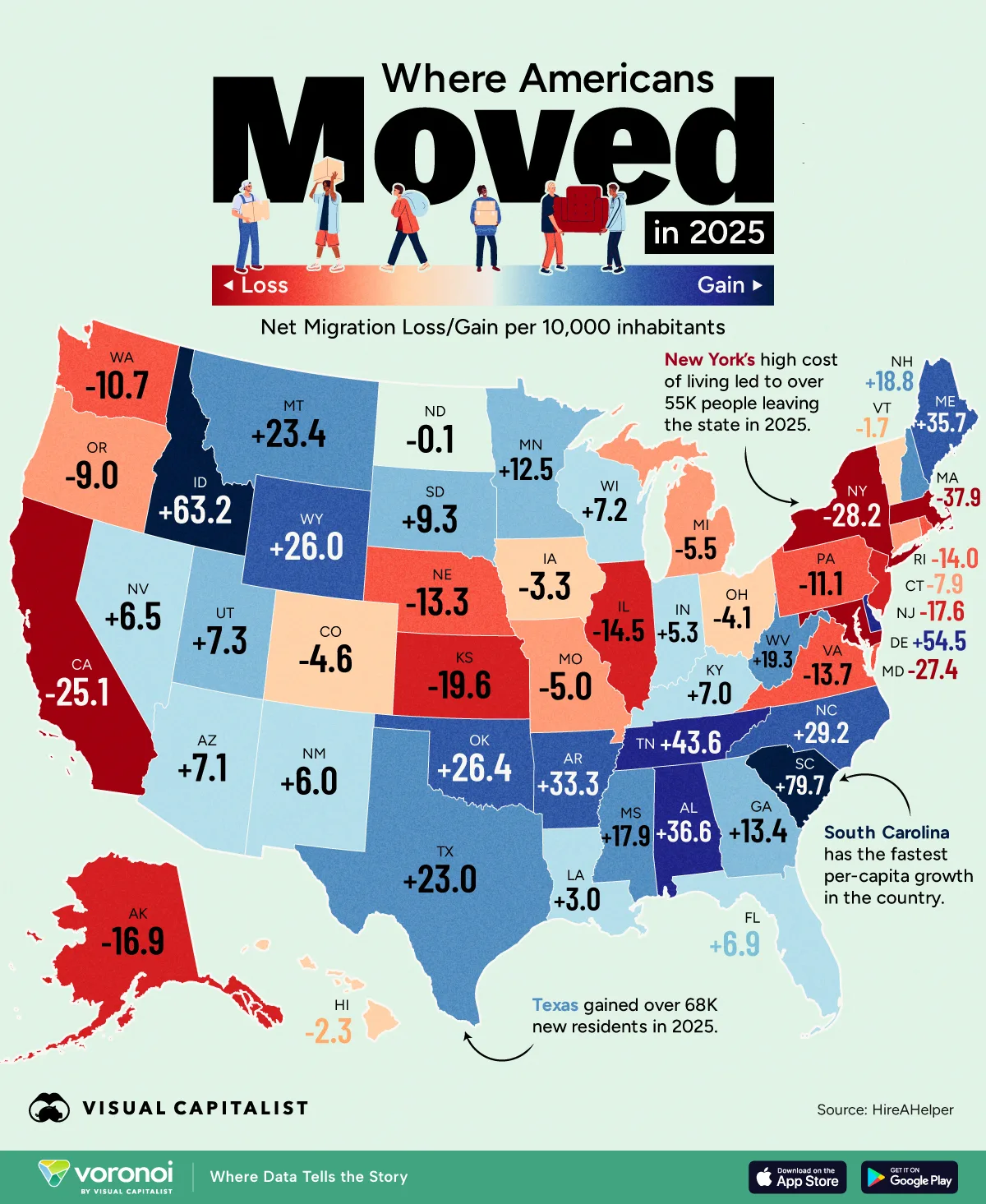
Migration context (2025): trend vs fit
National migration maps show where people are moving at a state level. That signal is useful context, but relocation decisions still hinge on neighborhood-level fit: commute, budget, schools, and safety.
- Use macro migration data to identify momentum.
- Use ZIP and neighborhood data to make the final decision.
Run your Charlotte neighborhood fit check →
Illustration for migration context; themes align with public reporting (e.g. HireAHelper, 2025).
On this page
Quick answer: who Charlotte is great for
Charlotte is great for
Finance & tech professionals (large employer base + remote-friendly)
Families prioritizing schools and space — many options across NC and SC
Big-city escapees (NYC, DC, Chicago) who want lower cost and milder winters
Remote workers who want affordability and still want a real city nearby
Think twice if…
You need Manhattan-level walkability everywhere — Charlotte is mostly car-oriented.
You refuse to drive — light rail only serves one corridor; most suburbs rely on highways.
You want coastal mild summers — July and August are hot and humid.
Cost of living snapshot
Use this as a directional comparison — not a quote for your mortgage or lease. Rents and home prices move with the market; tax rules have personal nuances.
| Metric | Charlotte (Thrive benchmark) | NYC (typical) | Atlanta (typical) |
|---|---|---|---|
| Median home price (metro-style) | ~$405K | ~$780K+ | ~$385K |
| 1BR apartment rent (typical range) | ~$1,380 | ~$3,200+ | ~$1,600 |
| State income tax (top of mind) | NC flat ~4.5%* | NY progressive* | GA ~5.75%* |
| Property tax (very rough) | ~0.8%* | Higher* | ~0.9%* |
*Charlotte home-price value uses Thrive's fixed Charlotte benchmark for consistent VS Charlotte comparisons. Tax rows are not tax advice; verify with a CPA for your state of residence and income.
Neighborhood finder — by lifestyle
This is where Thrive Synapse differs from generic listicles: we don't just name neighborhoods — we link to guides and live data so you can compare safety, schools, and commute with your priorities.
| Lifestyle | Where to start | Go deeper |
|---|---|---|
| Urban / walkable | South End, Dilworth, Plaza Midwood | South End guide · Sedgefield vs Dilworth · From a big city |
| Family / schools | Ballantyne, Waxhaw/Marvin area, Fort Mill SC | Steele Creek vs Ballantyne · Luxury suburbs · Fort Mill |
| Value / space | Steele Creek, Pineville, Concord/Kannapolis | Steele Creek vs Pineville · Steele Creek · Concord & Kannapolis |
| Budget-friendly suburbs | Kannapolis, Concord corridor, Gastonia (verify commute) | Concord & Kannapolis |
| SC border (taxes / schools) | Fort Mill, Indian Land (Lancaster Co.) | Fort Mill guide · SE corridor |
Also explore SouthPark, University City, Lake Norman, and Ballantyne reimagined for corridor-specific tradeoffs.
Charlotte job market
Charlotte is a banking and healthcare headquarters town with strong tech, logistics, and professional services growth. Names you'll see on job boards include Bank of America, Truist, Honeywell, Lowe's, Atrium Health, Duke Energy — plus a long tail of fintech and insurance operations.
Sectors: finance, healthcare, tech, logistics, energy, and corporate shared services. Metro unemployment has generally tracked the U.S. average in recent years; for the latest numbers, check the BLS release for Charlotte–Concord–Gastonia. Average pay varies sharply by role — finance and tech often lead broad regional averages, but your offer depends on level and employer.
Schools: NC vs SC (why it matters)
This is the section many national guides skip. North Carolina and South Carolina are different states — different funding models, governance, and reporting. When you cross the border from Charlotte into Fort Mill, Indian Land, or Lancaster County, you are not just changing ZIP codes: you may change school district, tax structure, and even how crime data is reported. That's why we built Thrive Synapse to show scores and sources per area, not a single "Charlotte" number.
Often-cited districts for families (starting points for research — verify assignments): Union County (Waxhaw, Marvin, Matthews area), Cabarrus County (Concord/Kannapolis orbit), and in SC Lancaster County (Fort Mill, Indian Land). Mecklenburg (CMS) covers many in-city addresses; magnet and lottery options add complexity.
| Topic | North Carolina (general) | South Carolina (general) |
|---|---|---|
| School governance | District-based (e.g. CMS for much of Mecklenburg) | Separate district systems (e.g. Lancaster, York County districts) |
| Taxes & fees | NC income tax + local property tax rules | SC income tax + different mill rates — compare with a CPA |
| Data | NC DPI / reporting for NC schools | SC DPI-style reporting for SC schools |
For composite school scores tied to neighborhood ZIPs, open Thrive Synapse and run a search — we surface school ratings alongside safety and commute.
What nobody tells you until you get here
- Charlotte is car-dependent for most families. Pick your neighborhood around your real commute — not the reverse — or you'll trade a beautiful house for a daily slog on I-77 or I-485.
- The NC/SC border matters more than you think. Taxes, school systems, and data sources can all change when you cross it. Don't assume a 10-minute drive means the same rules.
- Light rail is one corridor, not a metro-wide network. The LYNX Blue Line serves South Blvd / Uptown / north toward the UNCC area — most suburbs still require driving. See homes near the Blue Line.
- Summer heat is real. Plan for 90°F+ stretches and humidity — your utility bill and outdoor plans will notice.
Why this guide isn't like every other "Charlotte relocation" article
| Typical guide | Thrive Synapse + this hub |
|---|---|
| Generic neighborhood names | Safety & school scores tied to neighborhood data |
| No side-by-side comparison | Data tables and live snapshots |
| NC vs SC glossed over | Explained with links to SC posts |
| No tool | Explore + Thrive Score |
| Stale rent numbers | Live rental & school data in the product |
Find your Charlotte neighborhood
Tell us your priorities
Schools, safety, commute, budget — Thrive Synapse weights what you care about and ranks neighborhoods you can open on the map.
Explore Thrive Synapse →Prefer the map first? Open Explore and filter by ZIP.
Go deeper on specific areas
Every post below includes neighborhood context; many include live comparison tables.
90-day relocation timeline
- Before you move: Budget, employer details, school research (especially magnets), and a scouting trip that includes rush-hour drives.
- 30–45 days out: Pre-approval or rental paperwork; daycare waitlists if applicable.
- Move week: Utilities, mail forwarding, insurance updates.
- First month: DMV / registration, primary care, and local routines.
Practical: DMV, taxes, healthcare
New residents typically need an NC driver license and vehicle registration within state guidelines — check NCDMV for current rules. Property and vehicle taxes vary by county and state; SC vs NC is not a one-line answer. Healthcare: major systems serve the region; use your insurance network to pick providers.
Climate & lifestyle
Mild winters compared to the Northeast; hot, humid summers with long AC seasons. Sports (NFL, NBA, MLS), breweries, greenways, and weekend trips to the mountains or beach are a big part of local life — pick a neighborhood that matches how you want to spend Saturdays, not just weekdays.
FAQ
Is Charlotte a good place to relocate?
For many people, yes — job growth, relative affordability vs. coastal metros, and a major airport are draws. Fit depends on commute, schools, and budget.
Is Charlotte safe?
Safety varies by neighborhood and block. Use Thrive Synapse and local sources for the ZIPs you are considering.
Should I rent before I buy?
Often yes — especially if you are new to the metro or between two areas.
How is Charlotte different from Atlanta?
Both are Sun Belt growth hubs. Charlotte is smaller in footprint feel, finance-heavy, and slightly different in housing stock and traffic patterns — compare both with your job location.
You're not just moving to a city — you're picking a daily commute, a school district, and a lifestyle. Start with this hub, click into the guides that match you, then run Thrive Synapse when you're ready to put numbers to your priorities.